The Visibility Trap: Why Spiritual Authority Has Nothing to Do With Your Post Count
There’s a rot spreading through spiritual communities and it smells like performance anxiety dressed up as empowerment.
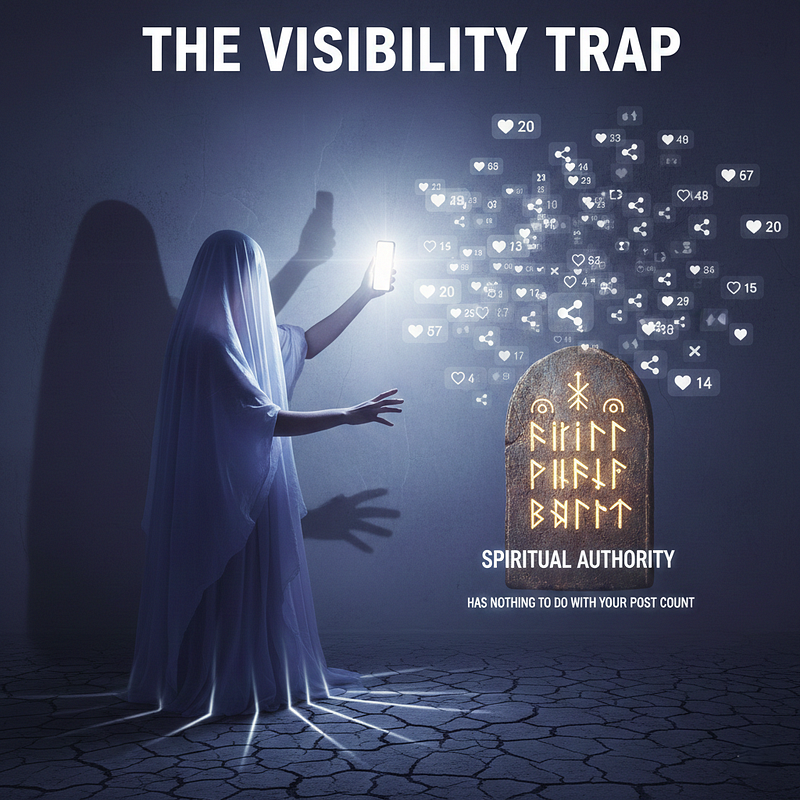
There’s a rot spreading through spiritual communities and it smells like performance anxiety dressed up as empowerment.
Somewhere in the last decade, we collectively lost the plot. We started measuring spiritual depth by social media metrics. We began treating silence as incompetence and privacy as proof of stagnation. We built an entire economy where your legitimacy as a practitioner hinges not on your discernment, your ethics or your actual capacity to hold space but on how often you show your face online, how many followers you’ve accumulated and whether you’re willing to turn your inner work into content.
This is not evolution. This is erosion.
The unspoken hierarchy that now dominates spiritual spaces has nothing to do with genuine development and everything to do with visibility politics. If you’re not constantly posting yourself, performing readings on demand, announcing events, documenting every so-called activation and download then you’re subtly pushed to the margins. You don’t get a seat at the table. Your perspective gets quietly dismissed. The message is clear and corrosive: if you’re not performing, you’re not progressing. If you’re not producing, you don’t really know anything worth hearing.
This is absurd. Worse than absurd, it’s actively dishonest and it’s doing real damage to people who are doing the actual work while everyone else is busy curating their spiritual brand.
When Did Development Become a Marketing Exercise?
Let’s be blunt about what’s happened here. Development, the real kind that involves breaking yourself open and putting yourself back together with more honesty than before is not a public spectacle. It doesn’t happen on a content calendar. It doesn’t unfold in neat, shareable chunks with perfect lighting and a three-point caption structure. Real development is messy, private, often invisible and sometimes it looks like nothing is happening at all because the most important shifts occur in silence.
But we’ve allowed a culture to take root where restraint gets mistaken for irrelevance. Where someone choosing not to broadcast their process is assumed to be behind, stuck or lacking something. Where the volume of your output has somehow replaced the quality of your discernment as the metric that matters. This is not just misguided. It’s dangerous because here’s what that culture actively rewards: recklessness over discernment, performance over integration, confidence theatre over actual competence. It creates an incentive structure where the people least qualified to be offering guidance are often the ones shouting the loudest because they’ve mistaken visibility for validation and noise for knowledge.
Intuition Is the Baseline, Not the Brand
let’s also address the thing that should be glaringly obvious but somehow keeps getting ignored in all this circus energy: intuition is the basic requirement of this work. Not the aesthetic. Not the follower count. Not the ability to sound mystical on camera. Intuition, the genuine capacity to sense what’s actually happening beneath the surface, to read energy accurately, to discern between your own unresolved material and legitimate guidance that’s the foundation everything else is supposed to rest on.
If someone cannot read a room, if they can’t sense when something feels misaligned, if they lack the self-awareness to recognise when their ego is driving the bus instead of their spirit, then it doesn’t matter how many courses they’ve taken, how many times they’ve posted about their gifts or how confident they sound when they’re delivering a reading. The fundamentals are missing and no amount of performance compensates for that deficit.
Some of the most dangerous guidance being offered right now comes from people who never stop talking long enough to actually listen. They’re so busy broadcasting their insights, building their platform, maintaining their visibility, that they’ve lost touch with the very thing that’s supposed to make them credible in the first place. They’ve confused presence with proof. They think because people are watching they must be doing something right but attention is not the same as accuracy. Popularity is not the same as wisdom.
The Invisible Work That Actually Matters
Here’s what gets erased in this performance-obsessed culture: some people are integrating. Some are unlearning patterns that have kept them disconnected from genuine intuition for years. Some are stabilising nervous systems that were never given the safety to develop proper boundaries or discernment in the first place. Some are doing the painstaking work of refining their gifts so they don’t confuse their own projections with spirit communication, so they don’t mistake emotional reactivity for intuitive hits, so they can tell the difference between what’s theirs and what’s someone else’s energy.
That work is invisible by nature. It doesn’t photograph well. It doesn’t translate into content. It often looks like nothing at all from the outside because the person doing it isn’t performing, they’re processing and that work the quiet unglamorous deeply responsible work of actually developing your capacity rather than just talking about it that’s what we should be valuing. Instead, we’ve built a culture that treats it like it doesn’t count unless it’s been documented and shared.
This is backwards and it needs to be called out for what it is: a massive distortion that actively punishes people for doing the right thing.
Why I Only Trust Mediums With at Least a Decade Under Their Belt
This is exactly why my standard is simple and non-negotiable: I only listen to mediums who have been doing this work for at least ten years. Minimum. Not because time alone guarantees competence but because a decade gives you enough distance to have failed, to have been humbled, to have realised how much you didn’t know when you started. It gives you time to have sat with grief that isn’t yours, to have navigated the ethical complexities that only show up when you’re actually holding space for people in crisis, to have developed the kind of discernment that only comes from repeatedly getting it wrong and learning how to do better.
Someone who’s been at this for less than that might be talented. They might be sincere. They might even be accurate some of the time but they haven’t had enough repetitions to stabilise their practice, to develop real humility, to understand the weight of what they’re doing and in a field where the stakes are this high where people are coming to you at their most vulnerable, that lack of experience isn’t just a gap in credentials. It’s a liability.
I don’t need to hear from someone who’s still figuring out how to differentiate their anxiety from their intuition. I don’t need guidance from someone whose entire framework was built in the last three years during a spiritual awakening they’re still actively processing. I need to hear from people who have been tested, who have sat in the discomfort long enough to know what’s real and what’s noise, who have enough mileage to recognise patterns and enough integrity to admit when they don’t know something.
That’s not gatekeeping. That’s basic discernment and if that standard makes some people uncomfortable, perhaps they should ask themselves why they’re in such a hurry to be seen as an authority when they’re still learning the fundamentals.
The Quiet Ones Might Be the Clearest
The loudest voices are not automatically the clearest. The most visible people are not automatically the most developed and the quietest practitioners are not automatically irrelevant or behind. Some of the most grounded, ethically sound, genuinely gifted people I know barely post at all because they’re too busy actually doing the work to worry about whether anyone’s watching.
They’re not performing their spirituality. They’re living it. They’re refining it. They’re holding themselves accountable to standards that have nothing to do with engagement rates and everything to do with integrity. If that challenges the current pecking order, if it disrupts the narrative that visibility equals legitimacy, then good. That narrative was always a lie and it’s long past time we stopped pretending otherwise.
Development was never meant to be a popularity contest. It was meant to be an inner reckoning. It was supposed to be about becoming more honest, more discerning, more capable of holding complexity without collapsing into certainty. It was supposed to strip away the performance not reinforce it.
So if you’re one of the people doing the quiet work, the invisible work, the unglamorous work of actually developing your gifts with humility and care, know that your restraint is not irrelevance. Your silence is not stagnation. You’re not behind because you’re not performing. You’re ahead because you understand that real authority doesn’t need to announce itself every 48 hours to remain legitimate and to everyone else who’s forgotten what this work was supposed to be about because they got distracted by the applause: the bus is moving but that doesn’t mean it’s going anywhere worth arriving at. Sometimes the wisest thing you can do is get off, step back and ask yourself whether you’re still doing the work or just riding the momentum because it feels good to be seen because if intuition isn’t guiding the journey, if discernment isn’t at the wheel, if humility isn’t keeping the ego in check, then it doesn’t matter how many people are on board with you. You’ve already gone off course.