The Reality of Contemporary Mediumship Development: Understanding the Distinction Between Psychic…
The landscape of modern mediumship is undergoing a significant transformation, though not always in ways that serve the integrity of the…
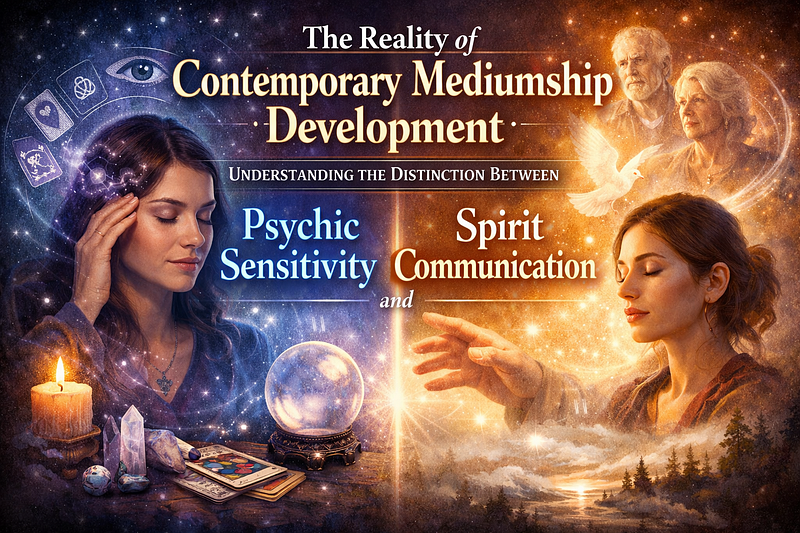
The Reality of Contemporary Mediumship Development: Understanding the Distinction Between Psychic Sensitivity and Spirit Communication
The landscape of modern mediumship is undergoing a significant transformation, though not always in ways that serve the integrity of the practice. What we’re observing across digital platforms and in accelerated training programs represents a fundamental misunderstanding of what mediumship actually is and how authentic mediumistic ability develops within the human consciousness.
The core issue centres on a categorical confusion between psychic functioning and genuine mediumship. These are not the same phenomenon, though they can appear remarkably similar to the untrained observer. Psychic ability operates within the realm of energy reading, pattern recognition and information gathered from the mental and emotional fields of living people. It accesses what already exists in the present moment, in the sitter’s energy field, their emotional body, their hopes and their unprocessed grief. This information can be deeply accurate and personally meaningful. A skilled psychic reader can perceive details about relationships, life circumstances, personality patterns and even probable futures based on current trajectories. The information arrives quickly because it’s being drawn from accessible energetic signatures that surround the living person.
Mediumship functions through an entirely different mechanism. It requires the practitioner to establish a specific altered state of consciousness in which they can perceive and interpret communication from a discarnate intelligence a consciousness no longer inhabiting a physical body. This process demands that the medium temporarily subordinate their own mental processes to allow another awareness to impress information upon their consciousness. The evidence that emerges through authentic mediumship carries specific characteristics: verifiable details about the personality, life events, manner of passing and particular mannerisms of a deceased individual that the medium could not have known through normal means or psychic perception alone.
The development of genuine mediumship capacity is not a matter of learning techniques or accumulating knowledge. It is a physiological and consciousness-based transformation that occurs gradually as the nervous system learns to sustain increasingly refined states of receptivity without collapsing into ordinary psychic functioning or imaginative projection. This development cannot be rushed for the same reason you cannot rush the seasoning of timber or the maturation of wine. The human instrument itself must undergo fundamental changes in how it processes subtle information, maintains energetic boundaries and discerns the source of incoming impressions.
What the current rapid-development model offers is primarily psychic training being labelled as mediumship. Students are taught to trust their first impressions, to speak with confidence, to deliver messages with emotional impact. These are valuable skills for psychic readers, but they bypass the essential work of mediumship: learning to recognise when spirit is genuinely present versus when you are accessing psychic information, reading the sitter’s energy field or drawing from your own psychological material. This distinction requires years of disciplined practice, rigorous feedback and the development of what we might call evidential literacy the ability to recognise what constitutes genuine spirit communication versus other forms of intuitive information.
The proliferation of individuals claiming mediumistic authority after brief training periods reflects several converging cultural forces. Social media rewards confident self-presentation and rapid content production. The spiritual marketplace incentivises the creation of new teachers and practitioners to meet consumer demand and grief itself is eternal and desperate, creating an endless audience for anyone offering connection with the deceased. These pressures create an environment where psychic sensitivity is regularly mistaken for mediumship, where personal conviction substitutes for evidential rigor and where the validation of an emotional response in the sitter is treated as proof of spirit contact.
The ethical implications are substantial. When psychic information is presented as communication from the deceased, several forms of harm become possible. The bereaved person receives comfort based on a false premise about what has occurred. The integrity of actual spirit communication becomes diluted in public consciousness and the developing practitioner internalises a distorted understanding of their own abilities, which prevents them from pursuing the deeper, slower work that genuine mediumship requires. They receive social reinforcement for a level of certainty they have not earned and cannot sustain under rigorous examination.
What often goes unnoticed in these discussions is that psychic ability is itself valuable and worthy of respect. The capacity to read energy, to perceive emotional truth, to offer insight into living people’s circumstances serves genuine purpose in the world. The problem is not that people are developing psychically it is that psychic development is being conflated with mediumistic development and practitioners are claiming a connection to the deceased that their actual ability does not support.
Authentic mediumship development looks fundamentally different from what is being marketed as rapid training. It involves extensive work in altered states of consciousness, learning to maintain a specific quality of mental stillness that allows spirit impression to emerge clearly. It requires the development of what is called “the power” a specific energetic condition that enables the bridge between physical and non-physical consciousness. It demands rigorous training in delivering evidence specific, verifiable details that demonstrate the presence of a particular discarnate personality rather than generalised or archetypal information that could apply to many deceased individuals.
The development process is necessarily slow because it involves the integration of experiences that challenge our ordinary understanding of consciousness and reality. The nervous system must learn to tolerate increasingly refined perceptual states without triggering anxiety responses or defensive psychological mechanisms. The practitioner must develop the emotional maturity to sit with uncertainty, to acknowledge when they are not perceiving clearly, to distinguish their own psychological material from genuine spirit impression. This maturation cannot be accelerated any more than you can speed the development of wisdom through life experience alone.
Those who understand the mechanics of consciousness involved in mediumship recognise where they are in their development. They can identify the difference between psychic perception and spirit contact in their own experience. They understand that claiming mediumistic authority before the capacity is stabilised serves neither spirit nor the bereaved. This restraint is not a lack of confidence it is a demonstration of understanding what mediumship actually requires.
The current environment rewards volume over depth, certainty over accuracy and emotional impact over evidential precision. These incentives work directly against the conditions necessary for genuine mediumistic development. Spirit communication does not arrive on demand or perform for an audience. It emerges through a specific internal state that the medium must learn to create and sustain, often in conditions of privacy and without external validation. The work is largely invisible and frequently unrewarding in conventional terms.
What we need is not a rejection of psychic development or an elitist gatekeeping of mediumship, but a clear understanding of what each actually involves and a restoration of honest language about the phenomena being experienced. Someone operating psychically can provide meaningful service without claiming to be a medium and someone developing mediumistically can be honest about their current level of ability without diminishing their worth or potential.
The practitioners who will sustain credibility over time are not those generating the most content or claiming the highest abilities. They are those maintaining the clearest boundaries around their actual capacity, pursuing rigorous development even when it offers no social media advantage and preserving their relationship with spirit communication as something sacred rather than performative. In an environment saturated with psychic noise being labelled as mediumship, this clarity of practice becomes the most valuable quality a developing practitioner can cultivate.