The Law of Exit Points: We Do Not Have Expiry Dates We Have Options
The spiritual world has long clung to a comforting fiction: that our death is a single, immovable date etched into the soul before birth. A…
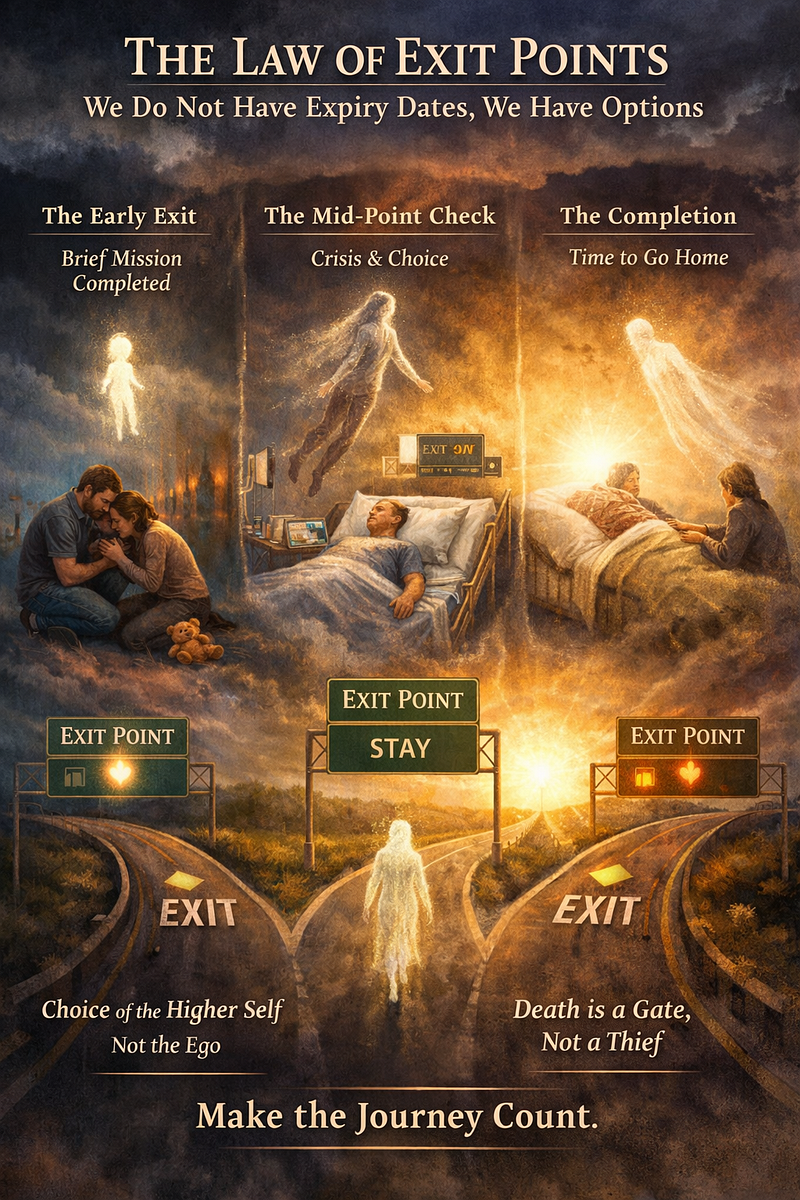
The spiritual world has long clung to a comforting fiction: that our death is a single, immovable date etched into the soul before birth. A fixed appointment. A final stamp. We are told we board life like a train, powerless passengers hurtling toward an inevitable wall. It is neat. It is fatalistic and it is wrong.
That is not how spirit operates. It is not how free will functions and it is not what reveals itself when you stand long enough at the bedsides of the living and the dying, watching the moment when something greater than biology decides whether to stay or go.
What emerges again and again is a different architecture altogether. We do not arrive with one expiry date. We arrive with options.
Through years of healthcare work and engagement with Spirit a consistent mechanism presents itself: the soul plans exit points. Not one ending, but several authorised windows where departure is possible. The soul is not reckless, nor is it naïve. It understands that life on Earth is unstable shaped by choice, accident and consequence. A single rigid endpoint would be impractical. So flexibility is built into the contract.
Before incarnation the soul agrees to certain lessons, relationships and pressures. But it also recognises that free will reshapes the terrain as life unfolds. To account for this volatility, most souls script three or four exit points along the timeline. These are not mandates. They are permissions. Off-ramps, not dead ends. When the moment arrives the soul may leave or it may continue on.
The earliest of these exits often arrives in infancy or early childhood. To the human mind, this is unbearable. We call it senseless, cruel, unfinished. Yet from the soul’s perspective this can represent a complete exchange. Some souls incarnate briefly to catalyse transformation in others to awaken unconditional love, to fracture complacency, to initiate a lineage into grief and depth. Their work is not measured in years. It is measured in impact. They are not victims of chance. They are teachers who finished early.
Another exit commonly appears in adolescence or young adulthood. This is the one most people recognise without realising what they are seeing. The accident you should not have survived. The illness that reversed against all odds. The moment when the body failed, consciousness floated and a decision was made. Near Death Experiences belong here. These are not glitches in the system; they are active checkpoints. At a soul level, a reckoning occurs. Has the work been done? Is there strength to continue? If the person lives it is not because death missed its mark it is because the soul declined the exit and chose the next chapter.
The final exit is the one we are most comfortable with: old age. The slow withdrawal. The body tiring, the lessons integrated, the attachments loosening their grip. This is the completion point where the soul disengages gradually and without protest it looks natural because it is.
The most confronting aspect of this doctrine is not death itself. It is choice. People recoil at the suggestion that a young person could choose to leave. “Why would they?” we demand clutching the logic of the conscious mind. The answer is that the decision is not made by the ego the part of us that fears death, loss and separation. It is made by the Higher Self the aspect that understands death is not an annihilation but a transition. When an exit point opens, the Higher Self assesses whether the body can still serve the mission whether the objectives have been met, whether continuation would deepen or dilute the work. If the answer is no, the exit is accepted.
This understanding matters because it reshapes how we carry both survival and grief.
If you are alive after a moment that should have taken you, your survival is not random. You passed an off-ramp. You consented to remain. There is unfinished business in your breath, whether you recognise it yet or not and when someone leaves young the language of theft begins to crumble. We say their life was stolen, cut short, robbed. The Law of Exit Points offers a harder steadier truth: they reached an authorised window and for reasons beyond the ego’s comprehension they took it. The departure was not a failure of fate. It was permitted.
This does not erase pain. It does not sanitise loss. But it does remove the lie that death is a criminal act against the soul.
Death is not a thief. It is a gate and if you are reading this breathing, present, conscious there is a strong chance you have already passed one exit and chosen to stay. Do not waste that decision. The road continues for a reason.
Make the next leg count.