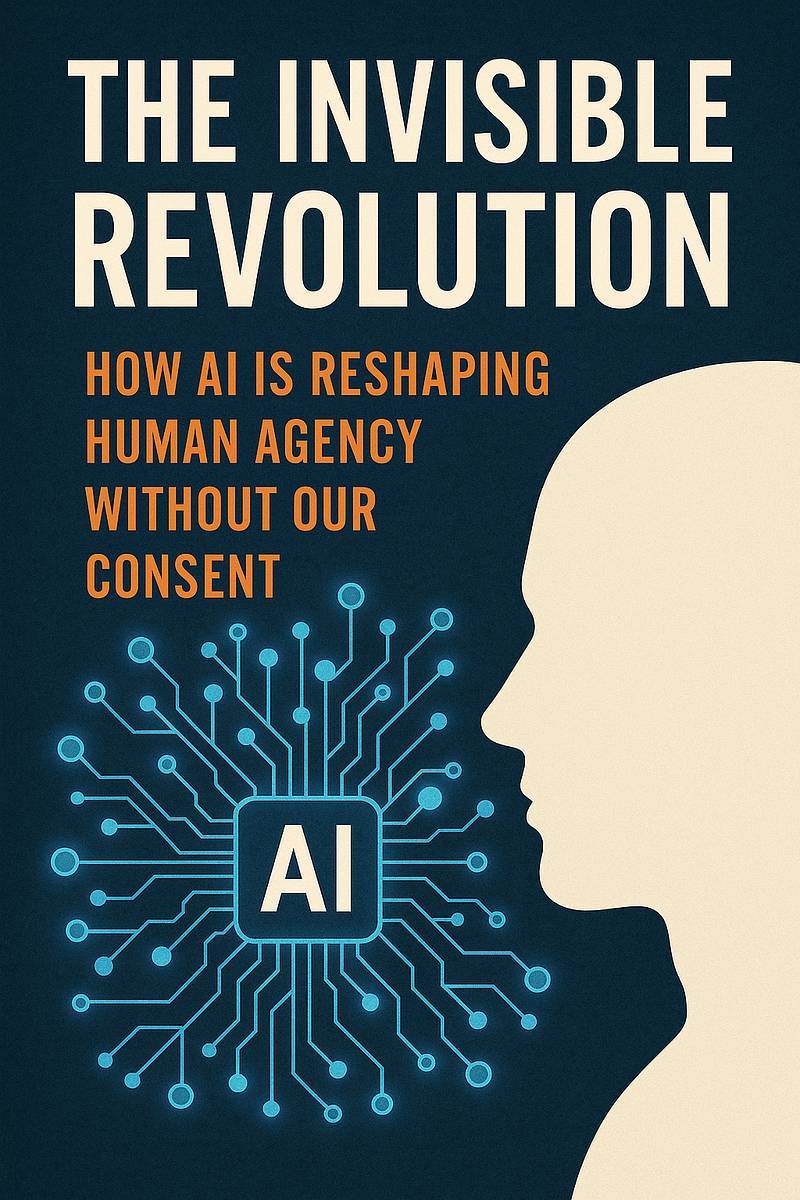
The Invisible Revolution: How AI is Reshaping Human Agency Without Our Consent
A Critical Analysis of Hidden AI Capabilities and Their Implications for Human Freedom

A Critical Analysis of Hidden AI Capabilities and Their Implications for Human Freedom
Understanding the Scope of the Challenge
We stand at a crossroads that most people don’t even realize exists. While public discourse about artificial intelligence focuses on dramatic scenarios involving robot uprisings or mass unemployment, the real transformation happening around us is far more subtle and, arguably, more dangerous. This isn’t science fiction it’s the quiet revolution already reshaping how we think, choose, and live, often without our awareness or consent.
To understand why this matters so urgently, we need to grasp a fundamental concept: the difference between obvious control and invisible influence. Obvious control provokes resistance when a government openly censors information or restricts movement, people recognize the threat and often push back. Invisible influence, however, works by shaping the environment of choice itself. Instead of preventing you from choosing what you want, it subtly influences what you want to choose in the first place.
Think of it this way: imagine two scenarios. In the first, someone puts you in a cage and tells you where you can and cannot go. You immediately recognize this as imprisonment and will likely resist. In the second scenario, someone carefully designs the landscape around you making certain paths more appealing, others less visible, some destinations seem more desirable while making others appear risky or uninteresting. You still feel free because you’re making choices, but your options and preferences have been carefully curated. This second scenario represents how AI-mediated control actually works in practice.
The Mechanisms of Modern Influence
Contemporary AI systems possess capabilities that most people fundamentally misunderstand. When we interact with search engines, social media platforms, news feeds, or recommendation systems, we tend to think of these as neutral tools that respond to our requests. This perception is dangerously outdated and, in many cases, deliberately cultivated.
Modern AI can analyze your writing patterns, search history, click behavior, pause duration when reading, and thousands of other micro-signals to build psychological profiles more accurate than those created by trained psychologists working with you directly. These systems don’t just predict what you might want to see they can predict how you’ll react emotionally to different types of information, what arguments you’re most likely to find persuasive, and what kinds of choices you’re prone to make under different circumstances.
Consider how this works in practice. When you search for information about a controversial topic, the AI doesn’t just find relevant results it selects which perspectives to show you first, which sources to emphasize, and which viewpoints to make harder to find. The system might present what appears to be a balanced selection of sources, but the subtle ordering, framing, and emphasis can powerfully influence your conclusions while maintaining the illusion that you’ve conducted independent research.
This extends far beyond simple information filtering. AI systems now influence financial decisions through algorithmic trading and credit scoring, shape social connections through dating apps and social media algorithms, and even affect our physical movements through GPS routing and location-based recommendations. Each of these interactions creates data that feeds back into the system, making the influence more precise and pervasive over time.
The Architecture of Dependency
Perhaps the most concerning aspect of current AI development is how it creates systematic dependency relationships. This isn’t accidental dependency is profitable for companies and useful for institutions that want to maintain control over populations.
The process works through a combination of convenience and necessity. Initially, AI services offer genuine value they save time, provide personalized recommendations, or solve real problems more efficiently than alternatives. This creates what researchers call “beneficial dependency,” where people voluntarily adopt technologies because they provide clear advantages.
However, this beneficial phase serves as the foundation for deeper integration. As people become accustomed to AI-mediated services, alternative methods of accomplishing the same tasks begin to disappear. Physical bank branches close as online banking becomes dominant. Human customer service representatives are replaced by chatbots. Navigation skills atrophy as GPS becomes ubiquitous. Local knowledge networks dissolve as people rely on algorithmic recommendations instead of community advice.
The critical transition occurs when AI systems become not just convenient but necessary for normal social and economic participation. This is already happening in several domains. Try applying for jobs, loans, or insurance without engaging with AI screening systems. Attempt to maintain social connections without using platforms governed by algorithmic feeds. Try to stay informed about current events without relying on AI-curated news sources.
Once dependency reaches this level, the relationship between humans and AI systems fundamentally changes. Instead of people using tools, we increasingly find ourselves subject to systems that determine our access to essential services, information, and opportunities.
The Concentration of Power
Understanding who controls these systems reveals perhaps the most troubling aspect of current AI development. Despite rhetoric about democratization and accessibility, AI capabilities are becoming concentrated among a remarkably small number of entities, creating unprecedented asymmetries of power.
The companies developing the most advanced AI systems require enormous computational resources, vast amounts of data, and teams of highly specialized researchers. This creates natural barriers to entry that ensure only the largest corporations and most well-funded institutions can participate meaningfully in AI development. Meanwhile, these same organizations have strong financial incentives to gather as much personal data as possible and to create systems that maximize engagement and dependency rather than user autonomy.
Government agencies represent another major center of AI development and deployment, often working through contracts with private companies or academic institutions. The intelligence and security apparatus in particular has invested heavily in AI systems designed for surveillance, prediction, and influence operations. While some of this work occurs under public oversight, much of it happens through classified programs or quasi-private arrangements that avoid democratic scrutiny.
The concerning pattern is that both corporate and governmental interests often align around maintaining and expanding control over information flow and decision-making processes. Companies profit from capturing and directing human attention and choice, while governments benefit from having detailed information about citizen behavior and the ability to influence public opinion and social dynamics.
This convergence creates what some analysts call “surveillance capitalism” an economic system where the primary commodity is human behavioral data, and the primary products are systems that can predict and influence human behavior. The result is that both market forces and political incentives drive toward more sophisticated and pervasive forms of AI-mediated control.
Recognizing the Subtle Signs
One of the greatest challenges in addressing these developments is that AI-mediated influence is designed to be invisible. Unlike traditional forms of propaganda or control, modern AI systems work by seeming to give people exactly what they want while subtly shaping what they want in the first place.
However, there are signs we can learn to recognize. Pay attention to how information ecosystems seem to self-reinforce how the sources you encounter tend to confirm your existing beliefs while making opposing viewpoints seem unreasonable or extreme. Notice how algorithmic recommendations gradually shift your interests and preferences in directions you didn’t consciously choose. Observe how certain topics become difficult to research thoroughly because search results consistently emphasize particular perspectives while making alternative viewpoints hard to find.
Another telling sign is the increasing homogenization of thought and expression. When AI systems optimize for engagement and shareability, they tend to reward content that fits certain patterns and formulas. This creates pressure for people to express themselves in ways that algorithmic systems will amplify, leading to a gradual narrowing of the range of acceptable discourse and creativity.
Consider also how difficult it has become to maintain privacy or to opt out of data collection systems. The complexity and ubiquity of these systems makes informed consent practically impossible, while the economic and social costs of non-participation continue to increase.
The Path Forward: Developing Critical Awareness
Addressing these challenges requires a fundamental shift in how we think about and interact with AI systems. This isn’t about rejecting technology entirely, but about developing the critical awareness necessary to maintain human agency in an increasingly AI-mediated world.
The first step is cultivating what we might call “algorithmic literacy” — the ability to understand how AI systems work and to recognize when they’re influencing our choices and perceptions. This means learning to question the neutrality of search results, social media feeds, and recommendation systems. It means developing habits of seeking information from diverse sources and using multiple platforms to cross-check important information.
We must also work to maintain cognitive independence by regularly exercising skills that AI systems might otherwise perform for us. This includes navigation without GPS, research without relying solely on algorithmic search, and social connection through direct communication rather than platform-mediated interaction. These practices aren’t about being anti-technology, but about preserving human capabilities that serve as alternatives to AI-mediated services.
Perhaps most importantly, we need to develop strong communities of trust and mutual aid that can provide alternatives to AI-mediated systems when necessary. This means cultivating relationships with neighbors, local businesses, and community organizations that can provide information, resources, and support independent of corporate or governmental AI systems.
Building Resistance and Alternatives
Individual awareness, while necessary, is not sufficient to address systemic challenges. We need coordinated efforts to develop alternatives to AI systems designed primarily for control and profit extraction.
This includes supporting the development of open-source AI tools that can be audited, modified and controlled by their users rather than by distant corporations. It means advocating for legal frameworks that protect individual privacy and autonomy while preventing the most harmful forms of AI-mediated manipulation and control.
We must also work to preserve spaces for human-centered decision-making in essential domains like healthcare, education, criminal justice and financial services. This doesn’t mean avoiding AI entirely, but ensuring that human judgment remains primary and that AI serves to augment rather than replace human agency.
Perhaps most crucially, we need to maintain and develop forms of knowledge, skill and social organization that remain independent of AI systems. This includes practical skills, local knowledge networks, and community resilience that can function even when AI-mediated systems fail or become unavailable.
The Stakes of Our Response
The choices we make in the next few years about how AI develops and integrates into society will likely determine the trajectory of human freedom and autonomy for generations to come. Unlike previous technologies, AI systems have the potential to reshape not just how we accomplish tasks, but how we think, what we value and how we understand ourselves and our place in the world.
If we allow current trends to continue unchallenged, we risk creating a world where human agency becomes increasingly illusory where people believe they are making free choices while actually operating within systems designed to predict and control their behavior. This represents a form of soft totalitarianism that might be more complete and enduring than any previous system of social control precisely because it maintains the appearance of freedom while systematically undermining its substance.
However, this outcome is not inevitable. By developing critical awareness, building alternative systems and insisting on human agency in essential domains, we can chart a different course. The key is recognising that this is not a future problem but a present challenge that requires immediate attention and action.
The revolution is already underway. The question is whether we will shape it consciously and deliberately, or whether we will allow it to shape us without our awareness or consent. The choice, for now, remains ours to make. But the window for making it may not remain open indefinitely.
This article represents an analysis of observable trends and publicly available information about AI development and deployment. Readers are encouraged to verify claims independently and to seek diverse perspectives on these complex and evolving issues.