The “Entertainment Only” Loophole: How Sacred Mediumship Gets Lost in Legal Fine Print
When Grief Meets Legal Disclaimers: The Heart-Wrenching Reality
When Grief Meets Legal Disclaimers: The Heart-Wrenching Reality
Picture this: You’ve just lost the most important person in your life. Your mum, your spouse, your child. The grief is suffocating. You’re desperate for any sign they’re still with you, still love you, still exist somewhere beyond the veil of death. In your most vulnerable moment, you reach out to a medium someone who claims to bridge the world between the living and the departed.
You pour your heart out. You share your deepest pain. The medium delivers messages that seem impossible to know, details that bring tears to your eyes and healing to your shattered soul. For the first time since your loss, you feel hope. You feel connection. You feel like you’re not drowning alone.
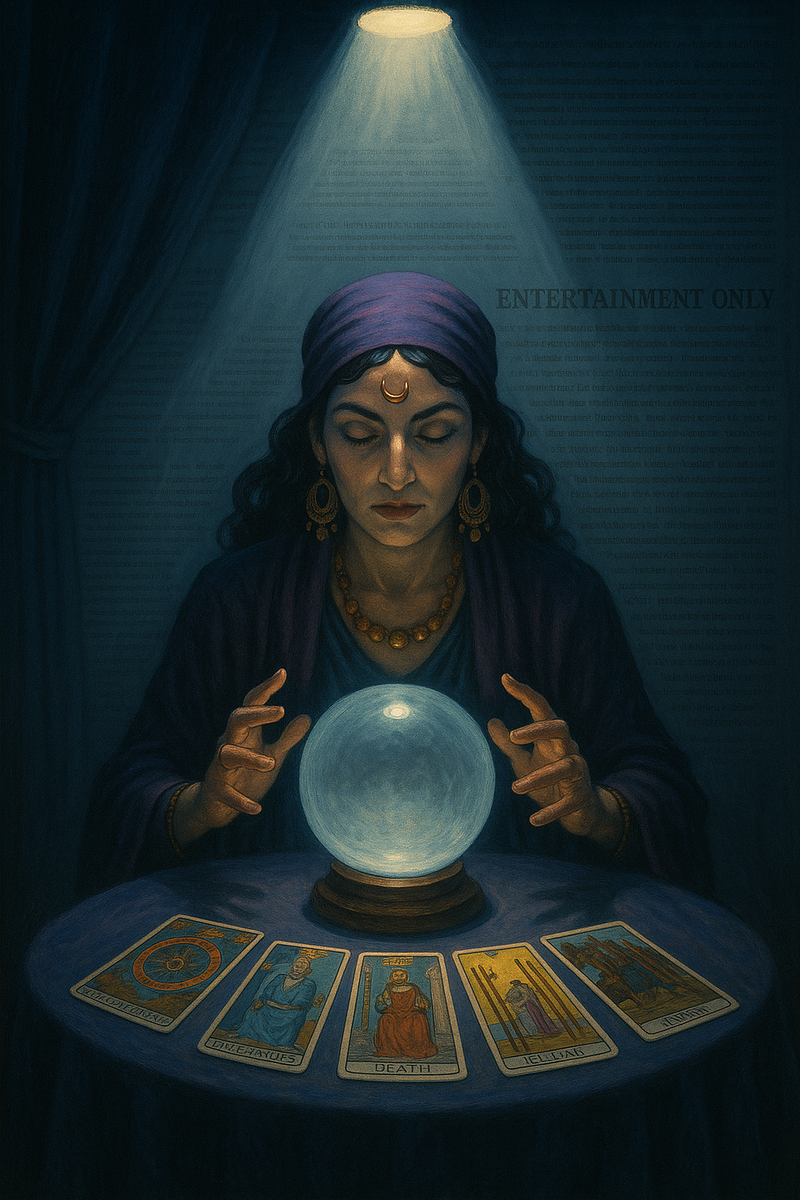
Then you see it, buried in tiny text at the bottom of their website: “For entertainment purposes only.”
Entertainment? Your grief isn’t entertainment. Your dead mother’s final words aren’t a parlour trick. The sacred connection between worlds isn’t a magic show.
The Legal Shield That’s Destroying Sacred Work
This disclaimer has become the spiritual community’s dirty little secret a legal loophole that allows genuine mediums to hide behind the same protection used by carnival fortune tellers and online psychic hotlines. Whilst lawyers crafted these phrases to avoid prosecution for fraud, they’ve created something far more damaging: they’ve reduced the most profound spiritual experiences to mere amusement.
The “entertainment purposes only” disclaimer was designed for a specific type of service: predictive psychic readings. You know the type crystal ball gazing sessions where someone claims to know if you’ll marry your current boyfriend or whether you’ll get that promotion next year. These are speculative services about future events, making them inherently unprovable and appropriately classified as entertainment.
But mediumship is fundamentally different.
The Sacred Art vs. The Sideshow
Real mediumship isn’t about predicting your future it’s about evidential communication with those who have passed. When a genuine medium tells you that your deceased father is showing them his favourite fishing hat, the scar on his left hand from a childhood accident and the specific nickname he called you that nobody else knew, this isn’t entertainment. This is evidential proof of survival after death.
Think about the difference:
Psychic prediction: “I see you meeting a tall, dark stranger next month who will change your life.” Unprovable, speculative, appropriately entertainment.
Mediumship communication: “Your grandmother is here. She’s showing me the blue ceramic elephant you kept from her house. She says you still have her wedding ring in the small wooden box on your dressing table and she wants you to know she’s been with you every time you’ve held it and cried.” Specific, evidential, sacred.
One is a guessing game. The other is proof of continued existence.
The Emotional Devastation of Dismissal
When legitimate mediums hide behind “entertainment only” disclaimers, they’re not just protecting themselves legally they’re invalidating the very people they claim to serve. Imagine receiving the most profound spiritual experience of your life, feeling genuine connection with your deceased loved one, only to have it legally classified alongside a Las Vegas magic show.
This disclaimer creates a cognitive dissonance that’s emotionally brutal for grieving people. The medium presents themselves as a legitimate spiritual adviser, charges serious money for their services, delivers life-changing messages, then legally classifies the entire experience as entertainment. It’s like a therapist ending every session with “Just kidding this was all just for fun!”
The Prosecution Problem
Here’s why this matters beyond hurt feelings: the “entertainment purposes only” disclaimer has become a get-out-of-gaol-free card for spiritual fraud. Someone can present themselves as a legitimate medium, charge hundreds of dollars for readings, make specific claims about communicating with the dead, then hide behind entertainment disclaimers when their clients discover they’ve been manipulated.
This makes legitimate prosecution nearly impossible. Crown prosecutors won’t pursue fraud cases against someone who technically labelled their services as entertainment, even when everything else about their presentation suggests otherwise. The disclaimer creates legal immunity whilst preserving the facade of legitimacy.
The Integrity Crisis
The most heartbreaking aspect of this epidemic isn’t the legal implications it’s what it reveals about the spiritual community’s integrity crisis. Genuine mediums who truly believe in their ability to communicate with the deceased are allowing lawyers to classify their sacred work as entertainment rather than standing behind their convictions.
If you genuinely believe you’re facilitating communication between the living and the dead, if you truly think you’re providing evidence of life after death, if you honestly feel you’re doing sacred work then why are you legally categorising it as entertainment?
The answer is simple: fear. Fear of lawsuits, fear of prosecution, fear of ridicule. But this fear is destroying the very credibility these mediums claim they want to establish.
A Call for Authentic Distinction
It’s time for the spiritual community to make a clear distinction:
Entertainment psychics who make future predictions and general statements should absolutely use entertainment disclaimers. They’re providing speculative services that can’t be verified and shouldn’t be taken as literal truth.
Evidential mediums who claim to provide specific, verifiable communication from deceased individuals should stand behind their work without hiding behind entertainment clauses. If you’re providing evidence of life after death, own it. If you’re facilitating genuine spiritual communication, claim it.
The current system protects fraudsters whilst invalidating genuine practitioners. It allows anyone to present themselves as a legitimate spiritual adviser whilst maintaining legal immunity. Most importantly, it transforms the sacred experience of connecting with deceased loved ones into legally-defined entertainment.
The Path Forward
Real change requires courage from authentic mediums. It means standing behind your work without legal safety nets. It means being willing to be held accountable for the claims you make and the services you provide. It means distinguishing yourself from entertainment psychics through your actions, not just your marketing.
For clients seeking genuine spiritual connection, demand clarity. Ask potential mediums directly: “Do you consider your work entertainment or do you genuinely believe you’re facilitating communication with deceased individuals?” Their answer and their willingness to stand behind it legally will tell you everything you need to know about their authenticity.
The dead deserve better than to be classified as entertainment. The grieving deserve better than legal disclaimers that invalidate their spiritual experiences. Genuine mediums deserve the courage to stand behind their sacred work without hiding behind carnival sideshow protections.
It’s time to separate the sacred from the sideshow. It’s time to distinguish genuine spiritual communication from entertainment speculation. Most importantly, it’s time to honour the profound nature of mediumship by refusing to legally classify it as anything less than what it claims to be: evidence of life beyond death.
The question isn’t whether mediumship is real it’s whether those who practise it have the integrity to stand behind their claims without legal escape clauses. The answer to that question will determine the future credibility of the entire field.
Your deceased loved ones weren’t entertainment when they were alive. Their continued existence shouldn’t be entertainment now.