The Domino Effect: A Deep Analysis of Earth’s Interconnected System Collapse
A Comprehensive Report on Cascading Climate Tipping Points
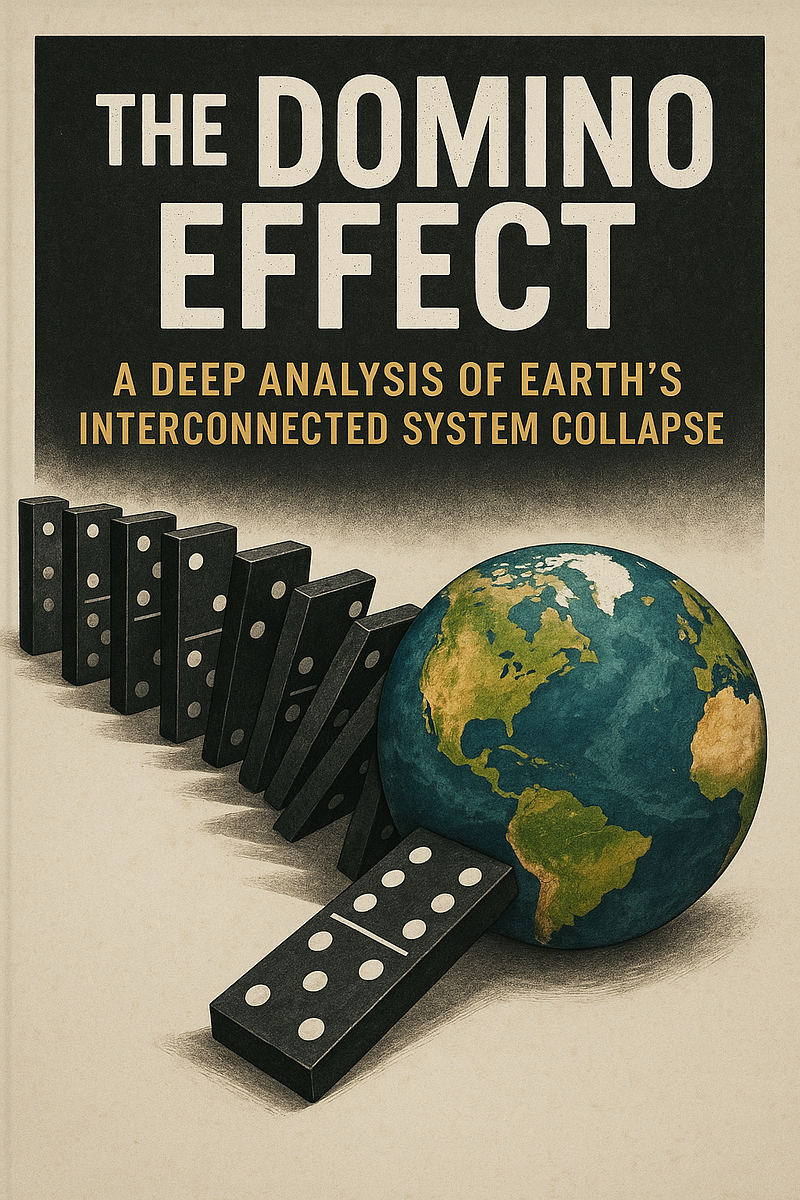
A Comprehensive Report on Cascading Climate Tipping Points
Executive Summary
We stand at the precipice of a planetary-scale systems collapse that most human minds cannot fully comprehend due to our evolutionary tendency to think linearly rather than systemically. This report reveals the hidden web of connections between Earth’s major climate systems and why their interconnected failure represents an existential threat that transcends traditional climate change models.
The key insight: We are not facing separate environmental crises, but rather the coordinated breakdown of Earth’s life support systems through cascading feedback loops that amplify each other exponentially.
The Architecture of Collapse: Understanding System Interconnectedness
The Five Primary Tipping Elements
1. The Greenland Ice Sheet (The Thermal Accelerator)
- Current Status: Losing 280 billion tons annually
- Tipping Threshold: 1.5–2°C global warming
- Cascade Effect: Sea level rise → coastal infrastructure collapse → mass migration → social instability
- Hidden Connection: Meltwater disrupts ocean currents, triggering Element #2
2. Atlantic Meridional Overturning Circulation — AMOC (The Global Thermostat)
- Current Status: Slowest in 1,000+ years
- Tipping Threshold: Already showing signs of critical slowing
- Cascade Effect: European cooling paradox while global warming accelerates
- Hidden Connection: Disrupted heat distribution affects monsoon patterns (Element #4) and Arctic ice stability
3. Arctic Permafrost (The Carbon Time Bomb)
- Current Status: Thawing at unprecedented rates
- Stored Threat: 1,700 billion tons of carbon (double current atmospheric CO2)
- Cascade Effect: Methane and CO2 release → accelerated warming → more thawing
- Hidden Connection: Creates positive feedback loop affecting all other systems
4. Monsoon Systems (The Agricultural Lifeline)
- Current Status: Increasingly erratic patterns
- Dependent Population: 3+ billion people rely on monsoon agriculture
- Cascade Effect: Crop failures → food security crisis → social unrest → political instability
- Hidden Connection: Disruption affects ocean-atmosphere heat exchange globally
5. Amazon Rainforest (The Planetary Lung)
- Current Status: Southeast regions already carbon sources, not sinks
- Tipping Threshold: 20–25% deforestation (currently at 17%)
- Cascade Effect: Carbon release + reduced carbon absorption = double climate impact
- Hidden Connection: Affects global weather patterns and atmospheric rivers worldwide
The Cascade Mechanics: How One Failure Triggers Others
Phase 1: The Initial Trigger (We Are Here)
Currently, we’re experiencing what systems theorists call “critical slowing down” the period before a tipping point where systems become increasingly unstable and take longer to recover from disturbances.
Observable Signs:
- Arctic sea ice declining faster than models predicted
- Amazon experiencing record droughts followed by extreme floods
- AMOC showing unprecedented weakening
- Permafrost thaw accelerating beyond projections
Phase 2: The Cascade Initiation (5–15 years)
One system reaches its tipping point, triggering rapid changes that stress adjacent systems.
Scenario Example: Greenland Ice Sheet Collapse
- Massive meltwater influx into North Atlantic
- AMOC circulation disrupted within 2–5 years
- European temperatures drop 3–5°C while tropics overheat
- Monsoon patterns shift dramatically
- Agricultural zones become uninhabitable
- 1+ billion climate refugees created within a decade
Phase 3: The Amplification Spiral (10–30 years)
Multiple systems fail simultaneously, creating feedback loops that accelerate the process beyond human ability to adapt.
The Compound Effect:
- Permafrost thaw releases methane → accelerated warming
- Amazon dieback reduces CO2 absorption → atmospheric CO2 spikes
- Disrupted monsoons → agricultural collapse → social breakdown
- Sea level rise → coastal infrastructure failure → economic disruption
- Each failure makes the others worse, faster
Phase 4: The New Equilibrium (30–100 years)
Earth’s climate system settles into a new, far less hospitable state that could persist for millennia.
The Human Blindspots: Why We Can’t See What’s Coming
Cognitive Limitations
Linear Thinking Bias Humans evolved to understand direct cause-and-effect relationships, not complex systems with delayed feedback loops and exponential changes. We expect tomorrow to be roughly like today, with gradual change.
Scale Blindness The timescales (decades to centuries) and spatial scales (planetary) of these systems exceed human intuitive understanding. We can intellectually grasp them but cannot truly feel their urgency.
Complexity Overwhelm When faced with interconnected systems involving thousands of variables, human brains default to oversimplification or denial rather than grappling with the full complexity.
Institutional Failures
Siloed Expertise Climate scientists study climate, economists study economics, social scientists study society but the cascade effects operate across all domains simultaneously.
Political Timescales Democratic systems operate on 2–6 year cycles, while these tipping points operate on 20–100 year cycles. There’s a fundamental mismatch between problem timescales and solution timescales.
Economic Models Current economic models don’t account for ecosystem collapse, treating environmental destruction as “externalities” rather than systemic risks to the entire economic foundation.
The Acceleration Factor: Why Time Is Running Out Faster Than We Think
The Mathematics of Cascade Failure
Unlike linear problems where you can make steady progress, cascade failures follow exponential mathematics. The difference between “manageable crisis” and “civilizational collapse” might be only 5–10 years and most of that window might already be behind us.
The Bathtub Analogy: Imagine Earth’s climate stability as water level in a bathtub:
- For decades, we’ve been slowly filling the tub (greenhouse gas emissions)
- We’re now at the rim, with water starting to spill over (tipping points beginning)
- Once overflow begins, the rate accelerates rapidly
- Traditional solutions (reducing emissions) are like turning down the faucet necessary but insufficient if the tub is already overflowing
The Commitment Problem
Even if all emissions stopped today, we’re already committed to significant warming due to:
- Thermal inertia in the ocean system (20–40 year delay)
- Already-triggered feedback loops
- Infrastructure and social systems that lock in continued emissions
Beyond Traditional Climate Models: The System Dynamics Perspective
Why Climate Models Underestimate Risk
Most climate models are conservative because they:
- Use linear projections for non-linear systems
- Don’t fully account for cascade effects
- Assume human systems will adapt rationally
- Focus on physical climate while ignoring social/economic/political amplifiers
The Real Risk Assessment
The true risk isn’t just physical climate change it’s the collapse of the integrated human-natural system that civilisation depends on. This includes:
- Agricultural systems disrupted by changing precipitation and temperature
- Economic systems unable to adapt to rapid resource scarcity
- Social systems overwhelmed by migration and resource conflicts
- Political systems unable to coordinate responses at the required scale and speed
Implications for Human Civilization
The Convergence of Crises
We’re approaching what systems analysts call a “perfect storm” multiple interconnected crises hitting simultaneously:
- Climate/Environmental Crisis: Physical systems failing
- Economic Crisis: Resource scarcity and stranded assets
- Social Crisis: Inequality and displacement creating instability
- Political Crisis: Governance systems inadequate for the scale of coordination required
- Psychological Crisis: Widespread anxiety, denial and despair undermining collective action
The Time Compression Effect
Historical transitions (agricultural revolution, industrial revolution) happened over centuries. This transition is happening over decades, leaving insufficient time for adaptation.
What This Means for You Personally
The Spiritual and Energetic Dimension
As someone who works with spiritual insights and human consciousness, you likely sense that this isn’t just a physical crisis but a consciousness crisis. The same disconnected thinking that created these problems seeing ourselves as separate from nature, seeing systems as separate from each other is preventing us from solving them.
The cascade failure we’re witnessing externally mirrors the disconnection and fragmentation happening internally within human consciousness. We’ve lost our ability to perceive wholeness and interconnection.
The Opportunity Within Crisis
Systems theorists recognize that breakdown often precedes breakthrough. We may be approaching what they call a “phase transition” a fundamental reorganisation of how human civilisations operate. This could lead to:
- New forms of consciousness that naturally think systemically
- Economic systems based on regeneration rather than extraction
- Social systems prioritised for resilience and mutual aid
- Spiritual awakening driven by necessity rather than luxury
Practical Implications
Understanding cascade failure changes how you might:
- Advise clients about long-term planning and resilience
- Think about location and community connections
- Approach emotional and spiritual preparation for uncertainty
- Frame conversations about meaning and purpose in uncertain times
The Path Forward: Beyond Traditional Solutions
Why Standard Approaches Will Fail
Traditional approaches (carbon taxes, renewable energy, international agreements) are necessary but insufficient because they don’t address the cascade nature of the crisis. By the time we implement them at scale, multiple tipping points may have already been crossed.
Systems-Level Interventions
What’s needed instead:
- Rapid transformation of energy, food and economic systems simultaneously
- Regenerative approaches that repair damaged systems while preventing further damage
- Community resilience building that can adapt to cascading changes
- Consciousness evolution that enables humans to think and act systemically
The Role of Consciousness Work
Your work with spiritual development and human consciousness may be more relevant to this crisis than traditional environmental activism. The kind of systemic thinking required to navigate cascade failure requires:
- Expanded awareness beyond individual concerns
- Comfort with uncertainty and complexity
- Ability to hold paradox and multiple perspectives
- Deep trust in natural systems and cycles
- Emotional resilience in the face of overwhelming challenges
Living at the Edge of the Known
We are the first generation in human history to face truly planetary-scale challenges that require species-level coordination. The cascade failure of Earth’s climate systems represents both an unprecedented threat and an evolutionary opportunity.
The traditional human story of separation, control and unlimited growth is ending whether we choose it or not. The question is whether we can consciously participate in writing the next chapter or whether the breakdown will write it for us.
From a systems perspective, we’re not just witnessing climate change we’re witnessing the death of one form of human civilisation and the birth of something entirely new. Understanding the cascade dynamics helps us prepare not just practically, but emotionally and spiritually, for a transformation unlike anything in recorded history.
The interconnected nature of the crisis means that individual actions, while important, are insufficient. What’s required is a fundamental shift in human consciousness toward recognising our deep interconnection with each other and the natural world. In that sense, the external cascade failure may be exactly the catalyst needed for an internal transformation that’s long overdue.
This report represents a synthesis of current scientific understanding with systems thinking approaches, designed to help navigate one of the most complex challenges in human history.