The Death Penalty Dilemma: Justice or Vengeance in the Charlie Kirk Murder Case
On 16 September 2025, Utah County prosecutors dropped a bombshell in the case of Tyler Robinson, the 22-year-old accused of assassinating…
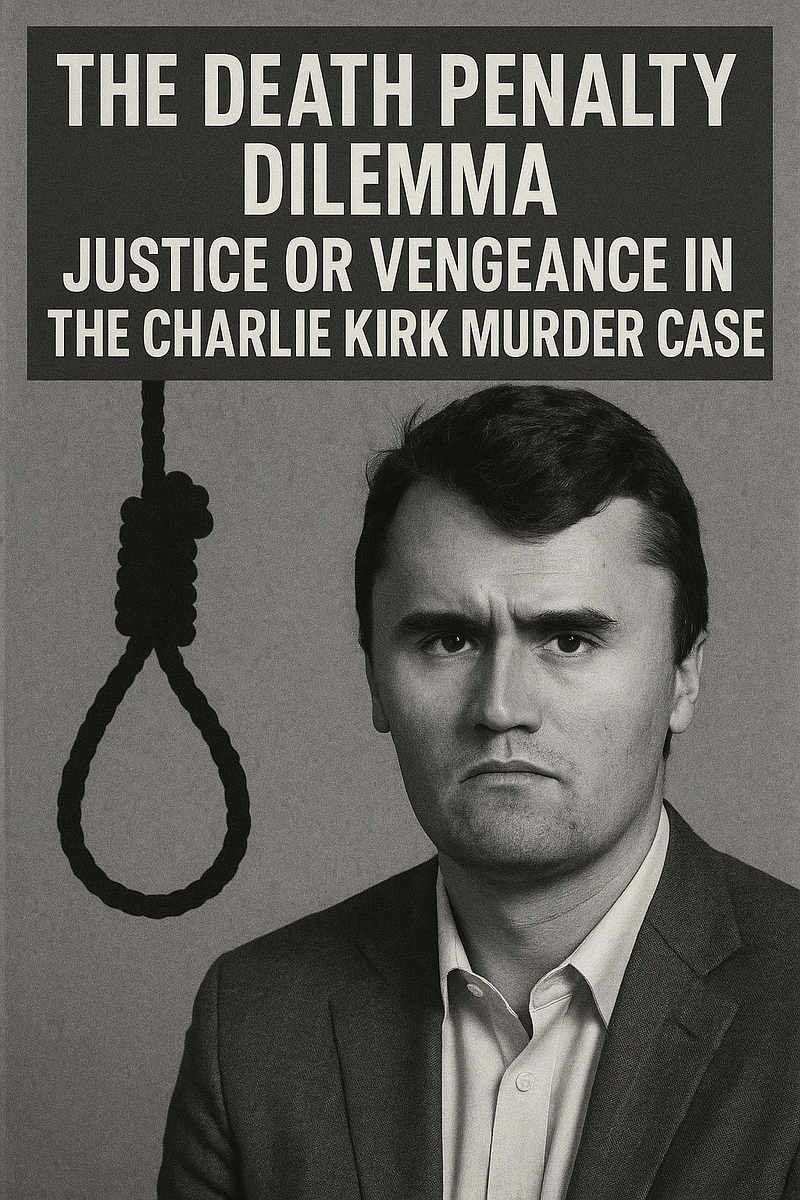
On 16 September 2025, Utah County prosecutors dropped a bombshell in the case of Tyler Robinson, the 22-year-old accused of assassinating conservative activist Charlie Kirk. Seven charges, including aggravated murder were formally filed with the state announcing its intent to seek the death penalty. The courtroom buzzing with tension saw Robinson appear virtually emotionless in an anti-suicide smock as the weight of the charges and the potential for lethal injection or even Utah’s rare firing squad loomed large. This development, whilst anticipated by some has reignited a fierce debate: does justice for one death demand another or is this a cycle of violence cloaked in the guise of retribution?
The Charges: A Litany of Evidence
The prosecution’s case against Robinson is formidable. Court documents reveal chilling details: a note left under his keyboard for his flatmate stating, “I had the opportunity to take out Charlie Kirk and I’m going to take it.” Text messages to his partner with whom he was romantically involved, confessed, “I had enough of his hatred. Some hate can’t be negotiated out.” Prosecutors allege Robinson planned the attack for over a week targeting Kirk for his political views during a speech at Utah Valley University on 10 September 2025. A single rifle shot from a rooftop 200 metres away pierced Kirk’s neck, killing the 31-year-old father of two before a crowd of 3,000.
Additional charges include felony discharge of a firearm, obstruction of justice and witness tampering bolstered by DNA evidence linking Robinson to a bolt-action rifle wrapped in a towel and a screwdriver found at the scene. Messages engraved on bullet casings hint at motives tied to politics and online culture, though specifics remain under scrutiny. Utah County Attorney Jeff Gray, in a press conference declared “I do not take this decision lightly” emphasising the decision to pursue capital punishment was based solely on evidence and the crime’s gravity.
The Death Penalty: A Divisive Pursuit
Utah, one of 27 states where capital punishment remains legal allows the death penalty for aggravated murder, particularly when the crime involves targeting based on political expression or endangers bystanders. The prosecution argues Robinson’s actions meet these criteria, citing the public nature of the attack and the presence of children in the crowd. Yet, the path to execution is fraught with legal hurdles. As California defence attorney Joshua Ritter noted prosecutors must convince a jury that the shooting created a “grave risk” to others, a high bar under Utah law.
The announcement has drawn polarised reactions. President Donald Trump a close ally of Kirk, called the activist’s death “a dark moment for America” and expressed hope for Robinson’s conviction and execution. Utah Governor Spencer Cox echoed this vowing to hold Robinson accountable for what he called a “political assassination”. Meanwhile, civil rights advocates and opponents of the death penalty argue that executing Robinson would only perpetuate a cycle of violence. The state’s history of capital punishment is sparse only two executions in the past 20 years, with inmates lingering on death row for an average of 34 years.
A Tragic Irony: Answering Death with Death
The pursuit of the death penalty raises a haunting question: does killing Robinson truly honour Charlie Kirk’s memory or does it deepen the tragedy? Kirk, a polarising figure and founder of Turning Point USA was known for his fiery rhetoric often criticised for disparaging marginalised groups. His supporters however saw him as a champion of free speech and conservative values, galvanising young voters. Robinson’s alleged motive fuelled by what he perceived as Kirk’s “hatred” suggests a personal vendetta perhaps intensified by online radicalisation as FBI Co-Deputy Director Dan Bongino speculated.
Yet, the irony is stark. A society mourning the loss of life now seeks to extinguish another. Critics argue that the death penalty, whether by lethal injection or firing squad risks glorifying vengeance over justice. Utah’s recent execution of Taberon Honie in August 2024, the first in 14 years underscores the state’s willingness to use capital punishment, yet failed attempts to abolish it in 2022 highlight deep divisions. The world watches as America grapples with its grief, anger and moral compass can a nation heal by taking another life or does it merely deepen the wounds?
The Road Ahead: A Nation Divided
Robinson’s next hearing is set for 29 September 2025, where he will be appointed a defence attorney and face the charges head-on. The case televised under Utah’s permissive courtroom media rules will likely captivate a national audience, amplifying debates over political violence, gun control and the ethics of capital punishment. Erika Kirk, Charlie’s widow has vowed to carry on her husband’s legacy urging young conservatives to join the movement. Her tearful address referencing their three-year-old daughter struck a chord: “What do you tell a three-year-old? ‘Daddy’s on a work trip with Jesus.’
As the legal battle unfolds, the Charlie Kirk case forces us to confront uncomfortable truths. Is the death penalty a fitting response to a targeted killing or does it risk further inflaming a polarised nation? The evidence against Robinson is damning but the moral question lingers: can justice be served without losing more of our humanity?