The Day the Children Came Home: A Nation’s Shame and the Tears We Refuse to Dry
They came back in silence.
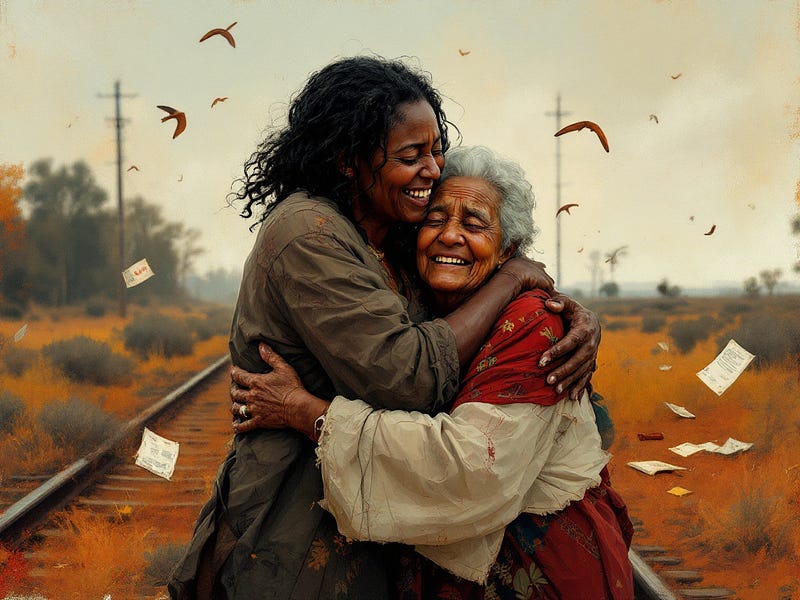
They came back in silence.
Not with fanfare. Not with parades. Not with the grand apologies a stolen generation deserved. They came back in stolen moments, in hushed phone calls, in letters postmarked from hell. They came back with new names, broken tongues and hearts carved hollow by a government that called it “protection.”
And Australia? Australia looked away.
The Train Stations of Shame
Imagine it: A child, no older than seven, standing on a platform in Perth, Sydney, or Brisbane, clutching a brown paper bag with all their worldly possessions. A stranger someone with a clipboard and a God complex had told them their mother didn’t want them. That their culture was a sin. That their skin was a curse.
Decades later, those same children now adults with ghosts in their eyes stepped off trains, buses and planes, searching for faces they barely remembered. Some found graves where homes should have been. Others found mothers who had spent lifetimes weeping into pillows, wondering if their baby was still alive.
This was not history. This was 1970s. 1980s. 1990s. This was yesterday.
The Stolen Generations didn’t end with a policy change. It ended with a thousand quiet reunions that no camera captured, that no textbook dare describe in full. Because how do you put into words the moment a 60-year-old woman meets her mother for the first time since she was three? How do you explain the rage of a man who realizes his “adoptive” family erased his language, his songlines, his name?
You don’t. Because Australia doesn’t want to hear it.
The Lies We Told Ourselves
We called it “assimilation.” We called it “for their own good.” We called it anything but what it was: genocide.
From 1910 to 1970 (and beyond, because some states kept stealing children into the 1980s), the government kidnapped Aboriginal and Torres Strait Islander children. They sold them to white families, locked them in missions, trained them to be servants. They banned them from speaking their language, beat them for crying for their mothers and told them they were lucky.
Lucky. As if being ripped from your mother’s arms was a gift. As if growing up believing you were unwanted was a blessing.
And when the Bringing Them Home report landed in 1997, when the truth was laid bare 100,000 children stolen what did Australia do?
We argued about the numbers. We said, “But it was a different time.” We elected a Prime Minister who refused to say sorry for another decade.
Even when Kevin Rudd finally apologised in 2008, it was too late for the ones who died waiting. Too late for the mothers who went to their graves never knowing if their child was alive. Too late for the fathers who drank themselves to death because the pain of losing their babies was unbearable.
And still, we act like we’ve made amends.
The Children Who Never Came Back
Not every stolen child made it home.
Some died in “care” beaten, neglected, buried in unmarked graves. Some took their own lives, unable to live with the shame of not knowing who they were. Some never found their families because the records were burned, or lost, or never kept in the first place.
And the ones who did return? They came back to communities fractured by grief, to Country they no longer recognised, to a culture they’d been taught to hate.
They came back angry. They came back broken. They came back determined to never let this happen again.
But it is still happening.
Right now, Aboriginal children are 10 times more likely to be removed from their families than non-Indigenous kids. Right now, grandmothers are fighting in court just to keep their grandbabies out of the same system that destroyed them.
This is not the past. This is child protection in 2025.
The Day We All Should Have Wept
There was no national mourning when the children started coming home. No minute of silence for the lifetimes lost. No monuments for the mothers who died of heartbreak.
Instead, we got a sorry that didn’t stop the stealing. A reconciliation that changed nothing. A flag that still flies over a country that never asked permission to exist.
We got “Closing the Gap” reports that gap wider every year. We got “Recognise” campaigns that recognise nothing. We got a Prime Minister who stands on stolen land and calls himself “proud”.
Where is the pride in this? Where is the justice?
What Do We Owe Them?
We owe them the truth. Not the sanitised version in school textbooks, but the raw, screaming truth: That Australia was built on stolen children. That every major institution the churches, the police, the governments conspired in this crime. That we are still benefiting from it.
We owe them reparations. Not just empty words, but land back. Money back. Power back. The least we can do is pay the rent.
We owe them a future where no child is ever stolen again. But right now, in 2025, Aboriginal kids are still being taken. Right now, families are still being torn apart. Right now, the same system that created the Stolen Generations is alive and well.
The Children Are Watching
The grandchildren of the Stolen Generations are growing up in a country that still doesn’t love them.
They see the flags. They hear the “Australia Day” celebrations. They watch as another Black death in custody trends for a day before the world moves on.
And they ask: “Will you steal us too?”
What Now?
We cannot fix what was done. But we can stop it from happening again.
- Demand an end to forced removals. #StopStolenGenerations
- Fight for a First Nations Voice to Parliament with real power, not just symbolism.
- Pay the Rent. Support Blak businesses. Amplify Blak voices.
- Teach the truth in schools. No more fairytales about “settlement”.
- Believe them when they say this is still happening.
The Day the Children Came Home Should Have Changed Everything.
But Australia didn’t listen then. And Australia isn’t listening now.
So here’s the question: When will we?
🔥 Share this. Tag your local MP. Donate to:
📢 Use the hashtags: #StolenGenerations #BringThemHome #AlwaysWasAlwaysWillBe
💔 And if you’re a survivor or a descendant we see you. We hear you. And we will fight with you.
This isn’t just an article. This is a mirror. Look into it. What do you see?