The Architecture of Coincidence
Deciphering the Universe’s Hidden Script
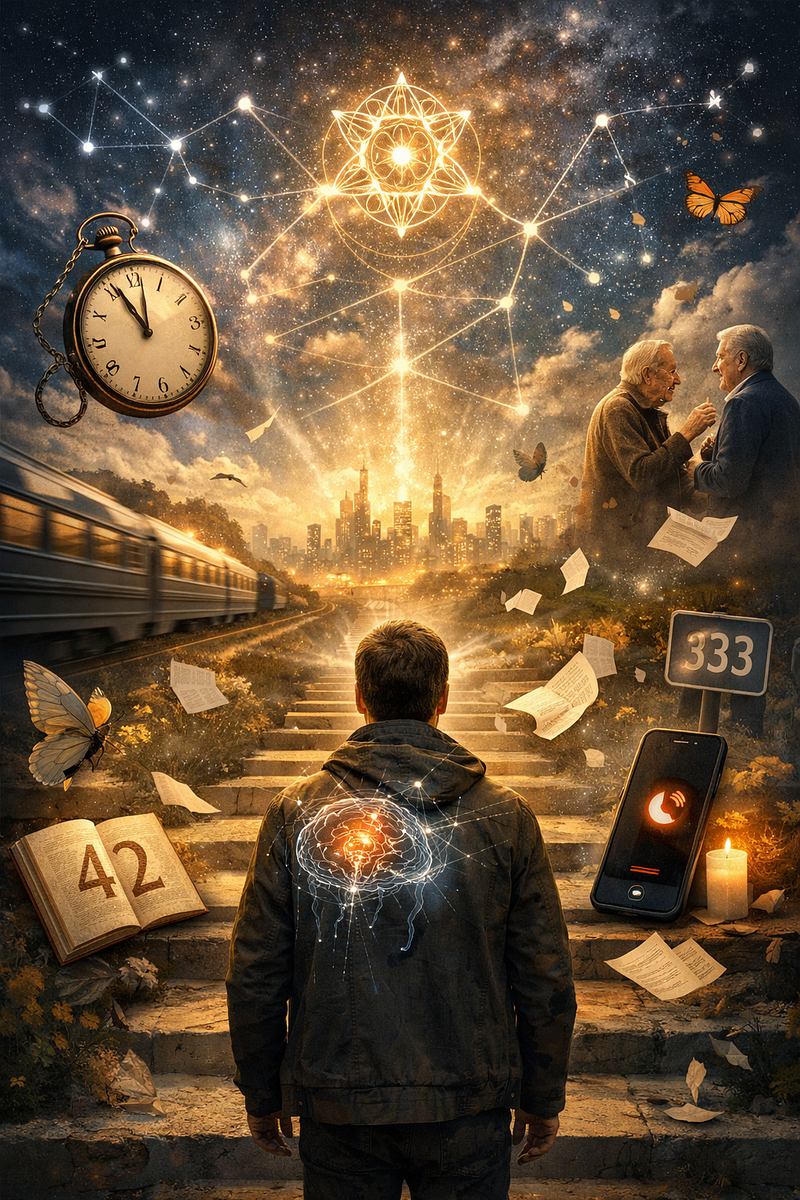
Deciphering the Universe’s Hidden Script
We usually dismiss a missed train, a flat battery or an unexpected encounter as background noise the friction of modern life. Random. Meaningless. Best ignored. Yet across psychology, neuroscience and behavioural science there is growing evidence that what we call “coincidence” is often the by-product of how human perception, attention and pattern recognition actually work. Not mystical. Not supernatural. But far more structured than we are taught to believe.
Seen through this lens daily life is not a chaotic blur of events. It is a stream of information filtered and heavily edited by the brain. The sense that “something is trying to tell me something” does not require belief in fate or cosmic design. It requires understanding how meaning emerges when internal states meet external data.
The Science of Synchronicity
The term synchronicity was formalised by Carl Jung, who used it to describe meaningful coincidences that occur without direct causal connection. Jung was careful not to claim supernatural forces at work. Instead, he argued that the psyche and the external world are not as separate as Western thinking assumes. Meaning arises when inner psychological states align with outer events.
For example, a person preoccupied with a moral dilemma might overhear a stranger discussing a similar issue at a café. The event is statistically ordinary; the interpretation is not. Jung’s insight was that humans are meaning-making organisms. When attention is primed in a certain direction, the world appears to “respond” not because it changes but because perception does.
Modern cognitive psychology supports this view. The brain constantly searches for relevance, coherence and narrative. Coincidences feel powerful because they compress complexity into significance. They tell a story our conscious mind was already half-writing.
Pattern Recognition, Not Prophecy
Humans are exceptional pattern detectors. This ability evolved for survival recognising faces, predicting movement, spotting threats. But the same machinery also identifies patterns in abstract domains: numbers, symbols, conversations, social behaviour.
Seeing recurring number sequences like 11:11 or encountering the same book recommendation several times in a week does not require metaphysical explanation. These experiences are often driven by attentional bias. Once something is emotionally salient the brain flags it repeatedly. The phenomenon is sometimes called the frequency illusion or Baader–Meinhof effect.
Importantly, this does not mean such moments are meaningless. They reveal what currently matters to the observer. Coincidences act as mirrors, reflecting priorities, anxieties or unresolved questions back to us.
Intuition as a Biological System
If synchronicity is the external pattern intuition is the internal mechanism that responds to it. Far from being mystical, intuition is rooted in neurobiology. The subconscious brain processes millions of bits of sensory information per second far exceeding conscious capacity. Much of this processing never reaches awareness but still informs behaviour.
A “gut feeling” to take a different route home or avoid a particular conversation often arises from subtle cues tone of voice, posture, environmental irregularities processed below conscious awareness. Neuroscientists describe this as implicit learning and rapid pattern integration.
In practical terms intuition is the brain’s summary report. It is not always correct but it is rarely random because attention is limited, the brain filters aggressively. The Reticular Activating System (RAS) a network in the brainstem, determines what information is allowed into conscious awareness. This is why setting intentions matters. When a person asks a specific question “What am I avoiding?” or “What matters most right now?” the RAS becomes tuned to relevant cues.
Techniques such as softening visual focus, reducing digital distraction and deliberately pausing during moments of frustration widen perceptual bandwidth. Instead of narrowing attention to the obstacle awareness expands to context: people, language, timing, bodily sensations.
Psychologists refer to this as metacognitive reframing stepping outside immediate emotional reaction to observe patterns across situations.
Delays, Disruptions, and Meaning
Frustrations like cancelled meetings or unexpected delays are especially potent moments for insight. They interrupt habitual scripts and force a shift in attention. Research on creativity and problem-solving shows that breakthroughs often occur during disruption not flow.
By asking, “What does this interruption allow me to notice?” individuals move from passive irritation to active interpretation. This does not mean events are “designed,” but that meaning can be extracted when awareness is applied.
Living With Cognitive Literacy
Treating life as a dialogue rather than a barrage of events fosters psychological resilience. People who engage reflectively with coincidence tend to report greater agency, coherence and emotional regulation. They are not surrendering responsibility to fate; they are refining perception.
Coincidences then are not messages from the universe. They are feedback loops between attention, expectation and reality. The “hidden script” is not written elsewhere it is co-authored moment by moment by the observing mind.
The world is speaking all the time. The real question is not whether meaning exists but whether we are attentive enough to recognise the patterns already in front of us.