Pauline Hanson’s Burqa Protest: Security First, Hypocrisy Laid Bare
Australia watched the Senate erupt Today, but only one senator forced the room to confront a truth our politics keeps dodging. Pauline…
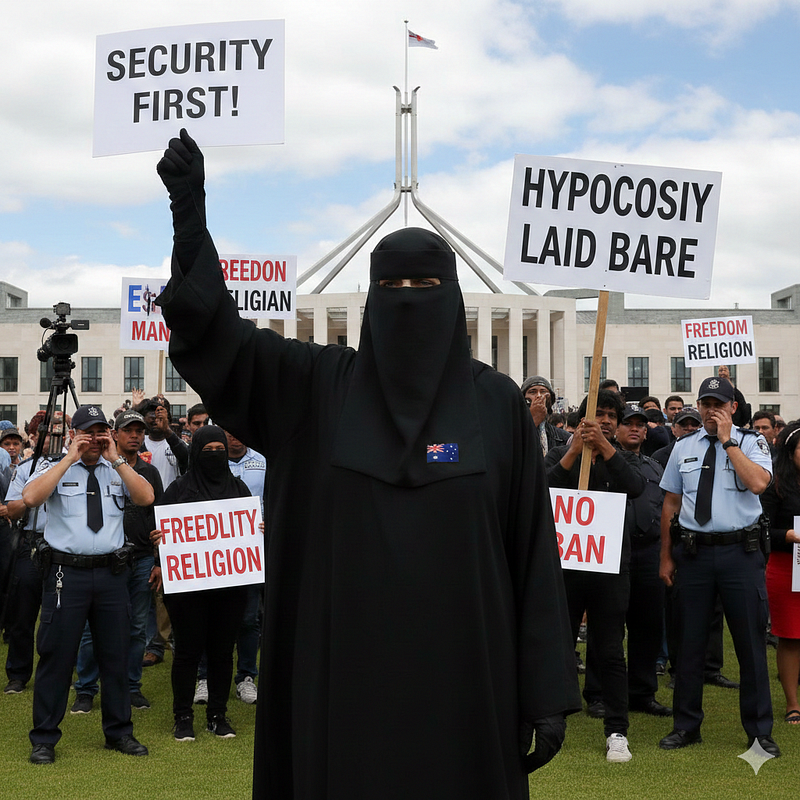
Australia watched the Senate erupt Today, but only one senator forced the room to confront a truth our politics keeps dodging. Pauline Hanson walked into the chamber wearing a full burqa not as provocation, not as mockery, but as a high-voltage reminder that Australia still hasn’t resolved a basic question: how do you protect a nation when its laws refuse to acknowledge the reality of concealment?
Hanson has made this stand before. In 2017, she used the same visual shock to expose the double standards built into our identity and security protocols. The chamber chose theatrics over conversation then and it’s doing the same now. The core issue Hanson raised the security risk posed by full-face coverings in sensitive environments remains unanswered. This time, she wasn’t challenging dress codes. She was calling out an inconsistency that puts Australians at risk.
In banks, airports and government offices, you can’t cover your face. Not with a balaclava. Not with a motorcycle helmet. Not with a scarf. Why? Because identity matters. Security matters. Yet, when it comes to burqas or niqabs, the rules suddenly dissolve under the weight of cultural discomfort.
France and Belgium didn’t ban full-face veils out of hostility they did it out of obligation. They recognised that public safety demands clarity, not exceptions. Hanson’s protest forces Australia to confront the question: why should our standards be any different?
Instead of addressing the principle behind Hanson’s act, her critics defaulted to outrage. Penny Wong delivered a furious rebuke. Mehreen Faruqi labelled it racist. Fatima Payman and Lidia Thorpe piled on with predictable indignation.
Thorpe went further shouting across the chamber, calling Hanson a “racist cow.” It was juvenile, aggressive and unworthy of the Senate floor. Yet those who preach respect and dignity were silent. Her behaviour was excused, even normalised, while Hanson’s protest was condemned as a “stunt.”
Critics love to forget their own theatrics. Wong has staged walkouts. Faruqi has waved placards mid-debate. Payman used her defection earlier this year to orchestrate a media spectacle. Thorpe’s outbursts have become so frequent they barely register anymore.
They call Hanson’s protest a stunt. But theirs? They call that activism.
The difference is stark: their demonstrations serve their politics. Hanson’s was aimed at public safety.
Hanson has long argued that burqas and niqabs aren’t only security concerns they’re symbols of female subjugation. They obscure identity, limit freedom, enforce silence. They jar violently with Australia’s hard-won commitment to women’s equality. Why should a garment associated with control be immune from scrutiny simply because it is religiously coded?
Accusing Hanson of racism is a political trick a way to shut down a conversation too many politicians are afraid to have. Security is not discrimination. Asking that everyone be identifiable in high-risk environments is not persecution. It’s consistency.
Hanson’s protest wasn’t an attack on Islam. It was a defence of common sense.
Australians are done with the theatre. They’re tired of watching Parliament dodge real issues and silence dissent under the guise of “protecting community harmony.” Hanson’s protest was deliberate, pointed and necessary and the fury that followed wasn’t an answer it was a deflection.
Her message cuts clean through the noise: if identity matters, it must matter for everyone. If security matters, it cannot be selective.
In an era of leaders terrified of offending someone, Pauline Hanson stood firm. She held the line and whether people love her or loathe her, they cannot deny that she forced the nation to confront a question our politicians hoped would stay buried.
Australia needed this moment. Not because it was comfortable but because it was true and truth, once spoken echoes long after the chamber falls silent.