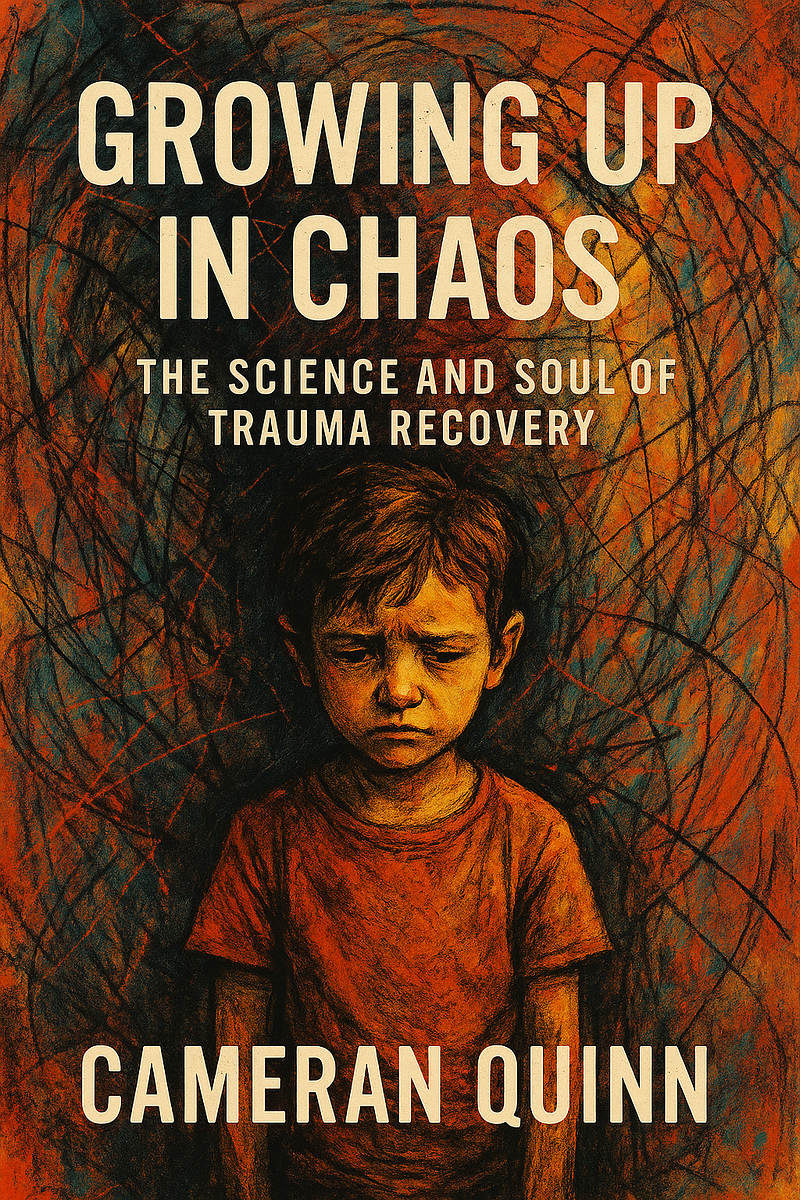
Growing Up in Chaos: The Science and Soul of Trauma Recovery
The Biology of a Chaotic Childhood
The Biology of a Chaotic Childhood
From the moment I was born, chaos wasn’t just an external force it was an intrinsic part of my existence. Stability was a foreign concept; predictability didn’t exist. For those of us raised in environments where uncertainty dictated every aspect of life, survival became an instinct rather than a choice. There were no instructions, only the necessity to adapt to anticipate shifts in energy, moods, and circumstances before they erupted into something unmanageable.
Here’s what science tells us happens in the brain: chronic unpredictability literally rewires our neural pathways. The amygdala that almond-shaped fear centre in your brain becomes hyperactive while your prefrontal cortex, responsible for rational thinking, takes a backseat. It’s like your brain’s smoke alarm gets stuck in the ON position while the part that says “chill, it’s just burnt toast” keeps shorting out. Fun times, right?
My earliest memories are not of warmth or security but of fear: raised voices, slammed doors, and the ever-present feeling of impending catastrophe. Grief was not a singular event; it was a constant presence, woven into the fabric of my daily reality. The death of my baby sister wasn’t just a devastating moment it was the catalyst that shattered what little semblance of structure existed. When trauma embeds itself so early in life, it ceases to be a distinct experience and instead becomes the lens through which the world is perceived.
The Body Keeps the Score: Living in Hypervigilance
Growing up in an unpredictable, volatile environment is akin to living in a perpetual state of hypervigilance. Every interaction is scanned for threats, every shift in tone or facial expression analysed for signs of danger. This heightened state of awareness doesn’t dissipate with time; it lingers, shaping relationships, self-worth and perceptions of love. Trust is difficult when experience has repeatedly demonstrated that safety is an illusion.
Researchers call this “trauma embodiment” where stress hormones like cortisol and adrenaline flood your system so consistently that your body forgets how to return to baseline. It’s like your body’s stress response gets stuck in fifth gear, and the gearshift breaks off in your hand. Your nervous system gets rewired to expect danger, even decades later. The body remembers what the mind tries to forget.
Let’s be honest nobody hands you a manual titled “So Your Fight-or-Flight Response Is Permanently Fucked: Now What?” They should, though. I’d read that.
For children raised in such circumstances, survival takes precedence over childhood. We learn to shrink ourselves, to anticipate the needs of others before our own, to take responsibility for circumstances beyond our control. Love is not freely given; it is conditional, earned through compliance and silence. The ability to navigate dysfunction becomes a skill set, but one that comes at the cost of emotional security and personal identity.
The Reality of Imperfect Love
Here’s something that needs to be said: the life I was given, with all its chaos and trauma, was the only life I knew. Despite the circumstances I was forced to face, this was my normal. My reality was shaped by parents who were struggling with their own demons, battling addiction while somehow still managing to keep us fed and housed each day.
And here’s the complicated truth that doesn’t fit neatly into trauma narratives: my parents showed their love to us in the way they knew how. Despite being drug dependant, they had this concept embedded somewhere deep inside them that they had to feed us and get us through each day, which is exactly what they did and our Grandparents picked up the rest. They may not have been capable of providing emotional stability or security, but they ensured our basic survival. That was their version of love, filtered through their own brokenness and limitations.
This creates a complex emotional landscape that doesn’t match the black-and-white stories we often hear about trauma. There’s no villain to clearly blame, no perfect victim narrative to embrace. Instead, there’s the messy reality of human beings doing their best with broken tools, loving their children through the fog of their own pain and addiction.
I cannot change that reality, and I’ve learned that attempting to rewrite it serves no purpose. The love I received was imperfect, inconsistent and often inadequate, but it was still love. Recognising this doesn’t minimise the trauma or excuse the harm, but it does provide a more complete picture of what survival looked like in my family.
Breaking the Cycle: When Trauma Starts with You
Here’s where my story challenges the conventional narrative about generational trauma. People love to say that addiction and dysfunction are inherited, passed down through family lines like some twisted heirloom. But the reality is far more complex, and sometimes the break in the chain happens in ways nobody expects.
Both lines of my family tell a story of achievement, education and hard work. My lineage is filled with teachers, lawyers, healthcare workers and successful business owners. These were people who built something meaningful with their lives, who contributed to their communities and raised their families with purpose and stability.
On my mother’s side, my nan worked in a chemist while my pop dedicated 40 odd years of his life to the same high school as a Careers Advisor aswell as many other roles. Think about that commitment nearly half a century shaping young minds, creating stability and structure for thousands of students. On my father’s side, my gran spent her career working in schools, while my grandfather built and ran a highly successful dragline business alongside his eldest son. This was a family enterprise that could have included my father, a legacy waiting for him to step into.
My parents were given the best possible start in life. They weren’t products of poverty, neglect or generational dysfunction. They had educated, stable parents who provided opportunities and support. Yet somehow, they became the first in both family lines to fall into the destructive patterns that would define my childhood.
My father chose drugs at fifteen, at a time when my grandparents didn’t even understand what drugs were. The world was different then they had just migrated to Australia from Scotland addiction wasn’t the widespread epidemic it would later become. My father was actually among the first people charged in New South Wales with heroin possession. The authorities barely understood what they were dealing with because it was so uncommon. My grandparents were navigating completely uncharted territory, watching their son disappear into something they couldn’t comprehend or combat in a new country that they had no idea how to reach for help, nor did the authorities.
This reality dismantles the simple explanations we often cling to about why people become addicted. There was no cycle of abuse to perpetuate, no generational poverty to escape, no pattern of dysfunction to continue. Sometimes, trauma and addiction emerge despite the best circumstances, despite loving families and abundant opportunities. Sometimes, the cycle starts with the person standing right in front of you, not with the ghosts of their ancestors.
Attachment Theory and the Science of Connection
When trauma hits in childhood, it doesn’t just mess with your head it fundamentally alters how you connect with others. Attachment theory isn’t just psychological mumbo-jumbo; it’s the scientific explanation for why some of us panic when people get too close or freak out when they step away.
There’s solid neuroscience behind this: early trauma disrupts the development of the right brain hemisphere, which handles emotional regulation and interpretation of social cues. It’s like trying to read emotional road signs with foggy glasses you’re guessing half the time, and usually guessing wrong.
The irony is that those of us who needed safe attachment the most got it the least. Then we spend our adult lives wondering why relationships feel like navigating a minefield while everyone else seems to have a map. Spoiler alert: they don’t have a map either, but at least their internal compass wasn’t magnetised by trauma.
Yet, amidst this turmoil, there was an unrelenting pull towards something greater. Though unrecognised at the time, that force was the beginning of my spiritual awakening the deep, unshakeable knowledge that life had to hold more than suffering.
The Intersection of Trauma and Spirituality
Survivors of profound suffering often find themselves at an existential crossroads: they either reject spirituality or cling to it as a means of making sense of their experiences. Traditional religion never resonated with me; it felt disconnected from the raw, unfiltered reality of trauma. But there were moments, undeniable, inexplicable moments that suggested there was more beyond what I could see.
Interestingly, research in post-traumatic growth shows that about 50–60% of trauma survivors report some form of spiritual transformation. It’s like the psyche, when cracked open by suffering, becomes permeable to experiences that wouldn’t otherwise penetrate our well-constructed defences.
I first encountered the concept of spirituality through the loss of my sister, Caitlin. My father took us outside on clear nights, lifting us onto his shoulders, and would ask us to find the brightest star in the sky. “That’s Caitlin,” he would say. “If you look closely, you’ll see her making the star flicker. She will always be the brightest star in the sky. You won’t always need me to see her; you can see her anytime just look for the brightest star.” I remember, at just six years old, the immense sense of relief that washed over me. Even though I couldn’t see or speak to her, my father’s words opened my mind to the truth that we don’t just die. There is so much more to life after death.
My mum, too, influenced my spiritual beliefs. She was deeply connected to angels, and they seemed to surround our home. “She is our guardian angel now,” Mum would say, reassuring us that Caitlin wasn’t gone; she was with us in a different form. This idea of angels my sister becoming one of them instilled in me a deep, unwavering belief in the communion of angels. They exist. My sister is one.
Trauma, Intuition, and the Highly Sensitive Person
There’s fascinating research on the link between childhood trauma and heightened intuitive abilities. Dr. Elaine Aron’s work on “Highly Sensitive Persons” suggests that about 20% of the population has a nervous system that processes sensory data more deeply and thoroughly. Add trauma to that mix, and you’ve got someone who can read a room faster than most people read a text message for me it can be the biggest curse but it has also been my biggest life-saving tool and has saved me in some very dangerous situations.
Mediumship and intuition were not just curiosities but necessary tools for understanding my own existence. The hyper-awareness I developed as a survival mechanism evolved into something profound a heightened sensitivity that allowed me to perceive the unseen, to connect with people on an unspoken level, and to recognise that suffering is not meaningless when it is transformed into purpose.
In scientific terms, this heightened perception might be explained through the concept of “thin psychological boundaries” a greater permeability between conscious and unconscious processes. Some researchers theorise that trauma survivors develop this as an adaptive mechanism, allowing them to perceive subtle environmental cues that might signal danger.
The Myth of Linear Healing: What Neuroscience Reveals
Society perpetuates the idea that healing is a linear journey leading to eventual peace. This is a fallacy, and now neuroscience backs this up. Healing is cyclical, nonlinear and NEVER truly complete. Some wounds remain open, some scars never fade. Grief does not dissolve; it shifts in form. Some days, it is a whisper. Other days, it is an unbearable weight pressing against the chest.
Here’s the scientific real talk: trauma literally changes your brain structure. The hippocampus responsible for memory processing can shrink up to 8% in PTSD sufferers. The neural networks formed during trauma are among the strongest in the brain. They don’t just disappear; they get integrated or rerouted.
Anyone who claims that pain completely disappears has never truly reckoned with it or understood basic neuroscience. What changes is not the presence of pain, but our ability to carry it. Over time, we learn to move with it rather than be consumed by it. Healing is not about erasure; it is about integration allowing the past to exist without permitting it to dictate the future.
For me, healing has not been about forced forgiveness or pretending that wounds no longer ache. It has been about reclaiming my story, giving myself permission to feel without guilt, and acknowledging that my pain is valid. It has been about understanding that while my past will always be a part of me, it does not have to confine me.
The Permanence of Grief: A New Understanding
I have come to understand that grief is a permanent companion. It does not leave; it adapts. It weaves itself into the fabric of who we are, changing form but never disappearing. This is not a flaw it is the nature of loss. To love deeply is to grieve deeply and that is a testament to the significance of what was lost.
Modern grief research has abandoned the old “stage theory” of grief. Instead, we now recognise the “dual process model” where people oscillate between loss-oriented and restoration-oriented coping. In plain English: sometimes you’re drowning in grief, and sometimes you’re building a new life. Both can happen in the same damn day, sometimes within the same hour. And that’s completely normal.
Those who tell you that time erases pain are lying or selling something. Time does not heal; it teaches. It forces you to find new ways to carry what you cannot put down. And honestly, would you want to completely forget? The pain exists because the love existed. They’re two sides of the same coin.
Neuroplasticity: The Science of Transformation
Healing does not mean the past ceases to matter. The echoes of trauma remain, surfacing in unexpected ways. But rather than seeking to erase them, I have chosen to understand them, to coexist with them, to use them as a foundation for something greater.
The science of neuroplasticity gives us hope: our brains can form new neural pathways throughout life. Each time you respond differently to an old trigger, you’re literally rewiring your brain. It’s like blazing a new trail through a dense forest the first few times are hard as hell, but eventually, that path becomes the default route.
This is not a plea for sympathy. I share my story for those who carry their own pain in silence, who believe they are alone in their suffering. Survival is not the destination; growth is. And growth does not mean the absence of pain it means forging meaning from it.
For Those Still in the Trenches
If you’re still in the thick of it, know this: the exhaustion you feel is real. Trauma recovery requires more energy than people realise. Your brain is literally rewiring itself, and that process consumes about 20% of your body’s energy. No wonder you’re tired. No wonder simple tasks feel impossible sometimes.
But here’s the good news that scientific research confirms: resilience isn’t something you’re born with it’s something you build, like a muscle. Every time you survive a flashback, every time you choose self-compassion over self-destruction, every time you reach out instead of isolating you’re strengthening that resilience muscle.
If you have endured chaos, if grief still lingers in the corners of your mind, know this: you are not alone. The pain may never fully leave, but neither will the strength it forged within you. You were never meant to be broken beyond repair you were meant to rise, to reclaim your power, to transform your suffering into something extraordinary.
The journey is never easy. There will be moments when you feel like you are drowning, when the weight of the past feels unbearable. But in those moments, remember this: you have already survived the worst. You are still here. That is not a small thing. That is everything.
The Science of Post-Traumatic Growth
Research shows that between 50–70% of trauma survivors report positive psychological changes following their trauma what psychologists call “post-traumatic growth.” These aren’t just feel-good stories; they’re documented changes in brain function and worldview. Areas that show growth include greater appreciation for life, more meaningful relationships, increased personal strength, recognition of new possibilities and spiritual development.
It’s like trauma cracks you open, and then you have a choice about what to fill those cracks with. Gold or garbage it’s up to you. And some days, let’s be honest, it’s a little of both.
Healing is not about forgetting or moving on it is about moving forward with all that you have carried and all that you have learned. It is about recognising that even in the darkest places, there is still light to be found. And that light is you.
This is not the end of my story, nor is it the full scope of my experiences. But it is a part of my truth, and in sharing it, I hope to give voice to those who have yet to find theirs. Trauma shapes us, but it does not have to define us. We are more than what we have endured. We are what we choose to become.
And sometimes, what we choose to become is incredibly fucking beautiful.
To be continued..